

Context index · CDC/ATSDR
The Social Vulnerability Index can add community context to a surgical travel study. It cannot identify a vulnerable patient, explain an individual missed appointment or prove that social conditions caused a measured access difference.
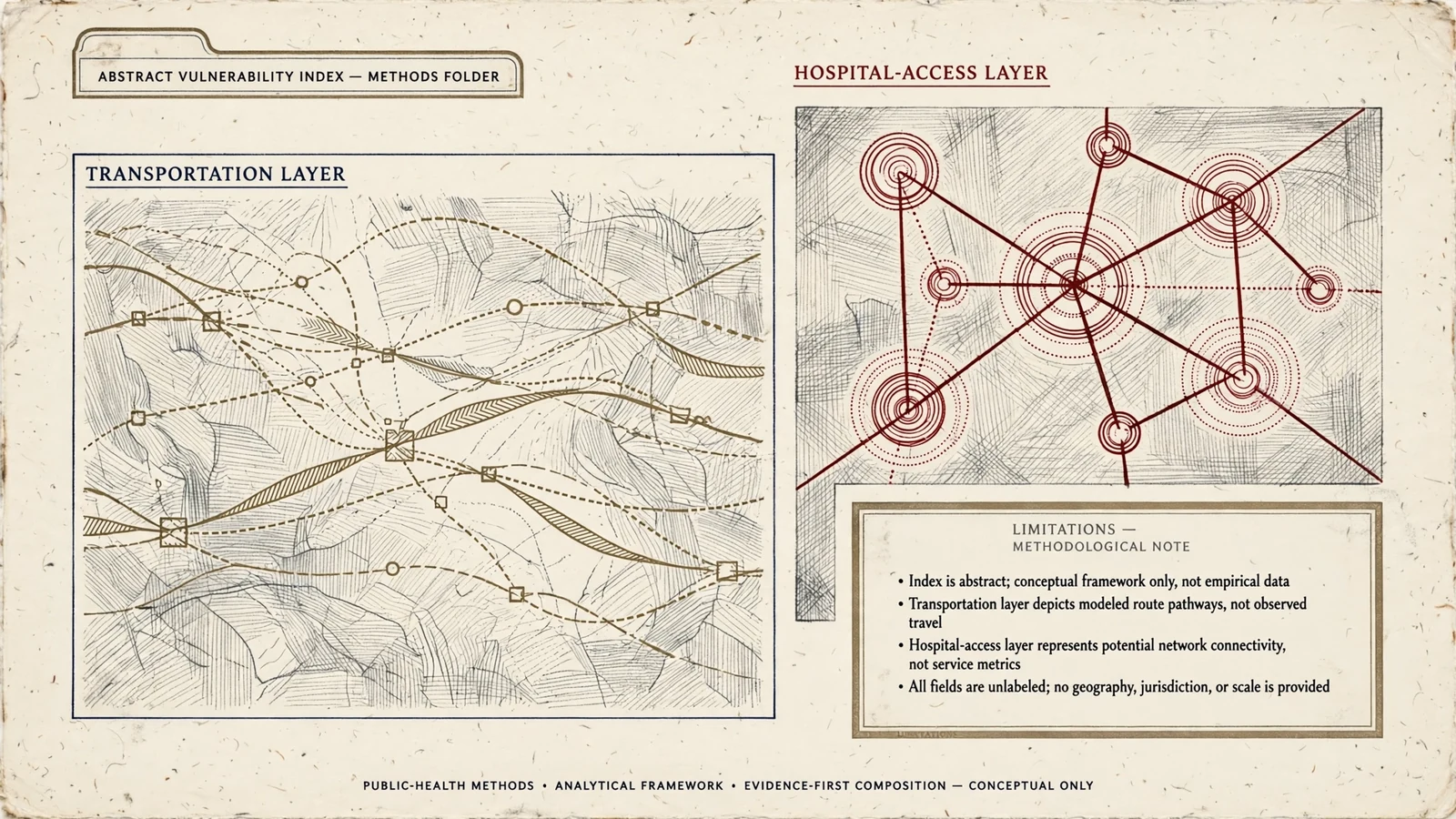
CDC/ATSDR page checked August 27, 2026
What SVI is designed to describe
CDC and the Agency for Toxic Substances and Disease Registry describe SVI as a place-based index, database and mapping application. It was developed to help public-health officials and planners identify communities that may need support before, during or after emergencies. The current method uses American Community Survey variables grouped into themes and an overall measure.
That purpose should remain visible when the index is used in health-services research. SVI describes area-level social conditions. A percentile or theme score is not a patient characteristic, a diagnosis or a direct measure of medical access.
Pair the index with a defined travel measure
“Travel burden” can mean straight-line distance, road distance, drive time, public-transit time, number of required trips or cost. A study should choose one definition before joining SVI data. Otherwise the index may be precise while the outcome remains vague.
Record the SVI release, geography, overall or theme field, travel-data date, origin rule and destination rule. A reader should be able to reproduce the join without guessing which version or boundary was used.
Area scores and individual experience are different
A resident of a high-scoring tract may have a car, paid leave and reliable support. A resident of a lower-scoring tract may lack all three. Area data can identify patterns worth studying, but it cannot assign circumstances to an individual. Reporting should use language such as “areas with higher SVI values” rather than labeling people.
The same caution applies to causation. If higher SVI values appear alongside longer estimated travel, the result is an association between two area-level measures. Facility distribution, specialist networks, insurance arrangements and referral practices may all contribute. The map alone cannot separate them.
A useful analysis has two layers
| Layer | What it answers | What remains open |
|---|---|---|
| SVI | Community context by defined geography | Individual barriers |
| Travel | Distance or time under stated rules | Completed access |
| Local verification | Current service availability | Patient-specific suitability |
Reporting without stigma
Maps should explain why the index is included and avoid treating a high score as a deficit inherent to a community. The reporting question is whether systems have accounted for documented contextual barriers. The answer should focus on resources, transportation, scheduling and service design rather than blame.
Use the surgical workforce and care access hub to connect this contextual layer with verified workforce and facility evidence.